_edited.png)
How To Sue Yourself
- Ayomide "Mide" Alabi
- Jun 14, 2025
- 4 min read

Salomon v. A. Salomon & Co. Ltd (1897)
In the last edition of this series, we took a look at the case of Donoghue v. Stevenson, the doctrine of negligence, and how it applies today.
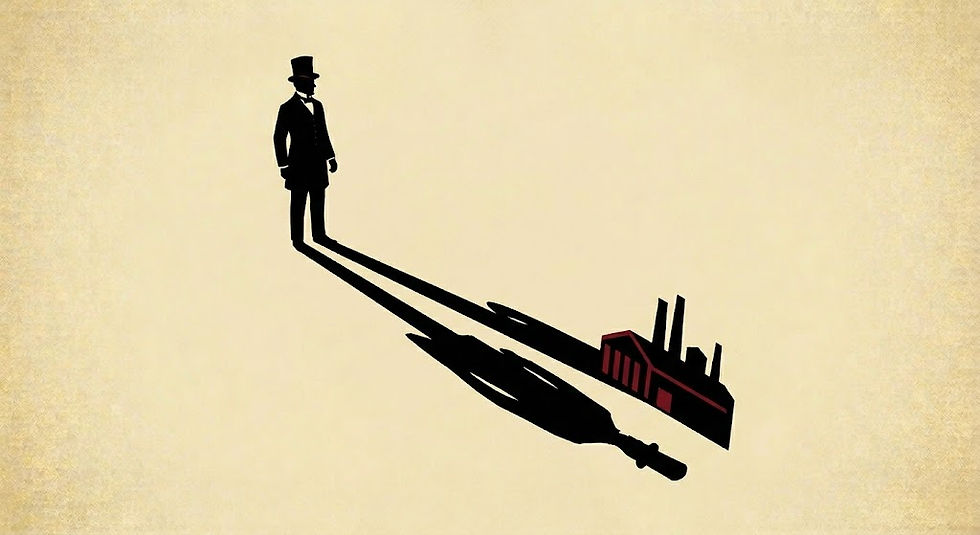
Today, our focus is centered around one man, a leather business, and how a perfectly legal loophole split him from his own company.
Let’s get into it.
So, what happened?
Meet Mr. Aron Salomon. He was a successful leather merchant in 19th-century England. The Companies Act back then required at least seven shareholders to form a limited liability company. Salomon had a bright idea: why not turn his thriving personal business into a company?
To do this, he roped in his wife, daughter, and four sons, each holding one share. Talk about a family affair, right? Salomon himself held the remaining majority and became managing director. In practice, though, he was the company.
Some years later, the company hit financial troubles. It owed a lot of money, and interestingly, one of its biggest creditors was Mr. Salomon himself because he had somehow loaned the company money as a secured creditor.
When the business went under, the other unsecured creditors protested, arguing that Salomon should personally pay the company’s debts since the whole thing was a sham, after all, it was a company in name only, and everyone knew it was Salomon pulling all the strings.
The argument was simple: he is the company, so he should be liable.
So what was the bone of contention?
Was A. Salomon & Co. Ltd a real, independent legal person, or just an extension of Mr. Salomon?
In other words, was Salomon hiding behind a legal façade to dodge personal liability?
What did the courts say?
The case went all the way up to the House of Lords. And in a decision that’s now company law gospel, they held that once a company is properly incorporated, it is a separate legal person, distinct from its members and directors, even if one person owns almost everything.
Translation: The company was not Salomon, and Salomon was not the company. As a secured creditor, he was entitled to be paid first before the unsecured creditors.
And as for the other creditors? They had to queue up behind him.
Why is this case important?
Salomon v. Salomon practically invented modern company law’s principle of separate legal personality.
It’s the reason why if you open a registered company today, whether it’s for your suya joint, an event-planning business, or a software start-up, that company is its own person in the eyes of the law.
It can own property, it can sue and be sued, it can owe debts, and most crucially, its debts are not automatically your debts.
This is also where the phrase “limited liability” comes from: your personal assets are protected from the company’s financial mess, unless you engage in fraud or dishonesty.
This principle sits firmly in both UK law and Nigerian company law today under the Companies and Allied Matters Act (CAMA) 2020.
Why should you care?
Because this is literally the foundation of every business you know, from the big banks to your cousin’s beauty boutique.
It means when your favorite app goes bankrupt, its CEO won’t necessarily have to sell his house. It means your Uncle Chuka’s pure water business can borrow money in its own name. And it means if you run a legit, properly registered business, you’re protected too.
But hold your horses for one second.
Before some sharp guy gets the wrong impression that this gives them the leeway to defraud people and avoid debts with fictitious companies, the thing is, this protection isn’t absolute.
And that’s where it gets interesting.
Exceptions: When the Court Can Ignore the Company’s Separate Legal Personality
Sometimes, the court or regulators will look beyond the company’s legal identity and hold the owners personally liable. In legal terms, this is called “lifting” or “piercing the corporate veil.”
Let’s quickly break down the major instances when this can happen:
1. Where the company is a mere façade or sham
If a company is formed to commit fraud, avoid legal obligations, or act as a cover for dishonest activity, the courts will disregard its separate personality.
Example: In Jones v Lipman (1962), a man transferred property to a company he owned to avoid fulfilling a contract. The court pierced the veil and enforced the contract against him.
2. Where there’s fraudulent, reckless, or illegal trading
If directors trade while knowing the company is insolvent or deliberately defraud creditors.
Section 672 of the CAMA 2020 says that courts can declare directors personally liable if a company trades with intent to defraud creditors.
3. Where statutory provisions allow it
Certain laws expressly permit holding directors or members personally liable in specific situations.
Examples under Nigerian law:
Section 119, CAMA 2020: Relating to disclosure of significant control — where failure to disclose can attract personal liability.
Section 93(4), CAMA 2020: Directors can be held personally liable for company debts incurred if they contravene the provisions regarding minimum issued share capital.
4. Where the company acts as an agent of its members
If a company is acting purely as an agent for its owner and not independently.
Example: In Smith, Stone & Knight Ltd v Birmingham Corporation (1939), the veil was lifted because the subsidiary was merely acting on behalf of the parent company.
The backlash after the Salomon case was intense. Some courts tried for years to sidestep it, but the principle held firm. Over 125 years later, it remains one of the most important cases you’ll ever study in company law and corporate law practice.
In some ways, it reminds me of when I first read the book Dr. Jekyll and Mr. Hyde back in junior secondary school. In the story, Dr. Jekyll creates a separate persona, Mr. Hyde, to indulge in his darker urges without staining his own reputation.
In a way, that’s what Salomon did by creating a company as a separate legal ‘person’ to shield himself from personal liability. But just like in the book, the law knows when to unmask Hyde and hold Jekyll responsible if things go too far.
So next time you hear someone say, "My company did this” or "My company owes that,” just remember—the company and the person are not the same thing… unless the law decides otherwise.



Comments