_edited.png)
The Ever Burning Flame: Gas Flaring in Nigeria

The names and some identifying details in this account have been changed to protect client confidentiality in ongoing litigation.
When Madam Efua[i] walked into the conference room in my firm’s Lagos office in 2024, she must have been close to seventy. She did not come with the urgency of someone fighting over land or compensation. She came slowly, carefully, carrying a plastic folder that looked older than some of the associates seated across from her.
Inside were hospital reports, lab results, and discharge summaries. The edges were worn. Some pages had been photocopied more than once, and I was certain there was a palm oil stain on the body of one of the scans she handed over. She placed the folder on the table and kept her hand on it.
“We no get voice,” she said quietly. "Na why I carry bus come.”
At the time, I was working with a full-service law firm handling pro bono matters for Niger Delta communities. We had seen disputes over oil spills and broken agreements, petitions about unpaid compensation, and even fabricated claims to extort corporations. This was different.
She was not asking for money.
She told us she had given birth to five children. Two were dead.
“Na lung cancer dem talk for my second born. My first daughter, she start to cough from when she be ten years old. E just dey worse.”
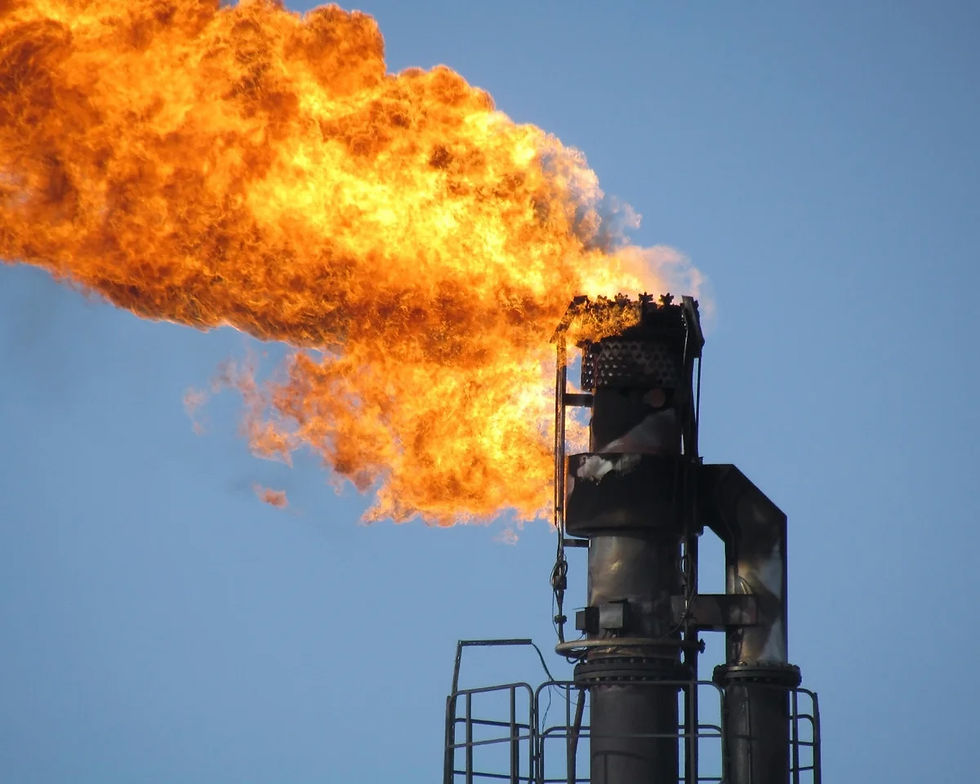
Near her community in Ebocha, Rivers State, a gas flare burns day and night. It has burned for years, and when the air is still, the smoke engulfs the community.
Unlike us, Madam Efua did not speak in the language of emissions or regulatory breaches. She spoke about coughing. About burials. About her kinsmen with strange diseases and the neighborhood kids that struggled to breathe.
Above her home, the flame continued to burn.
What burns above her village is part of a national pattern. Nigeria has struggled for decades to end routine gas flaring, even as it ranks among the highest globally for volumes burned. In 2023, Nigeria flared approximately 7.1 billion cubic meters of gas, according to the World Bank’s Global Gas Flaring Tracker. [ii]
The country has long had laws restricting the practice. The Petroleum Industry Act 2021 provides that gas produced during petroleum operations should not be flared except in limited circumstances. [iii]
Operators must submit plans showing how gas will be captured. Regulators can issue penalties for unauthorized flaring. [iv]
So the framework exists, and still, the flames have not disappeared.
Part of the explanation lies in the cost. Capturing associated gas requires infrastructure: gathering systems, processing plants, and pipelines. Those projects take time and significant capital. Under regulations administered by the Nigerian Upstream Petroleum Regulatory Commission, companies that flare gas pay financial penalties per unit flared. [v]
In some cases, paying the penalty is cheaper in the short term than building the required infrastructure. For corporate headquarters reviewing capital expenditure, the calculation often becomes financial before it becomes environmental.
The contradiction becomes sharper when viewed from Lagos. Nigeria’s power sector struggles with gas supply constraints even as flaring persists in oil-producing regions. [vi]
Businesses and households compensate with generators, factoring fuel costs into daily survival. And yet in oil-producing communities, gas continues to be burned.
The Nigeria Extractive Industries Transparency Initiative has documented billions in revenue losses from gas that could have been commercialized. [vii] The effects are environmental and economic.
For residents near flare sites, the consequences are less abstract. Environmental health research has examined the relationship between prolonged exposure to gas flaring emissions and respiratory conditions in parts of the Niger Delta, raising concerns about asthma, chronic bronchitis, and other long-term risks. [viii] While establishing direct causation in individual cases can be complex, the association between sustained exposure and negative health outcomes has been documented.
What many communities lack are well-equipped healthcare facilities for early diagnosis and specialist care. When serious illness is suspected, families must travel, which is an expense many cannot afford.
The Petroleum Industry Act introduced Host Community Development Trusts, requiring oil companies to allocate three percent of their annual operating expenditures to community-focused projects. The intention was to ensure that communities affected by extraction see tangible improvements in infrastructure and services.
But the existence of a fund does not automatically translate into functioning systems. In his memoir, From Storeroom to Boardroom, former NLNG Managing Director Dr. Babs Omotowa recounts disputes where funds for schools and health centers became entangled in local politics, with community leaders treating allocations as leverage rather than public resources.
Host community development trusts are structured to channel money into affected communities, but control often rests with local power brokers. Residents may know money has been allocated but have little visibility into how it’s spent.
Madam Efua did not speak about sections of the Act or the structure of a trust. She spoke about her grandchildren.
She told us she is old. Whatever the smoke has done to her, it has done. She does not expect to undo her own history. She wants something different for the children still running around her compound.
She did not want them boarding a bus, years from now, with their own plastic folders.
When I think about that meeting, I sometimes picture her return journey. The long road out of Lagos. The hours back toward Rivers State.
And then, as the bus approaches her community, she sees it again: the flare, rising above the trees, steady as ever.
Madam Efua once told us that when she was younger, the sky over her village looked brighter, the trees seemed greener, and the air felt lighter in her chest. That was over a half century ago.
For the children in her community, the light that now dominates the night comes from the flare, and they have never known the sky she remembers.
It is her hope they will one day look up and know a different reality: nights without smoky clouds and sunny days underneath a brighter sky.
[i] Not real name
[iii] Petroleum Industry Act 2021 (PIA), S105 — S107
[iv] ibid. (iii)
[vi] https://nerc.gov.ng/index.php/component/content/article/87-publications/652-2023-quarterly-report



Comments