_edited.png)
Moving Africa: Public Transport as a Key to Urbanization
- Ayomide "Mide" Alabi
- Jun 9, 2025
- 5 min read

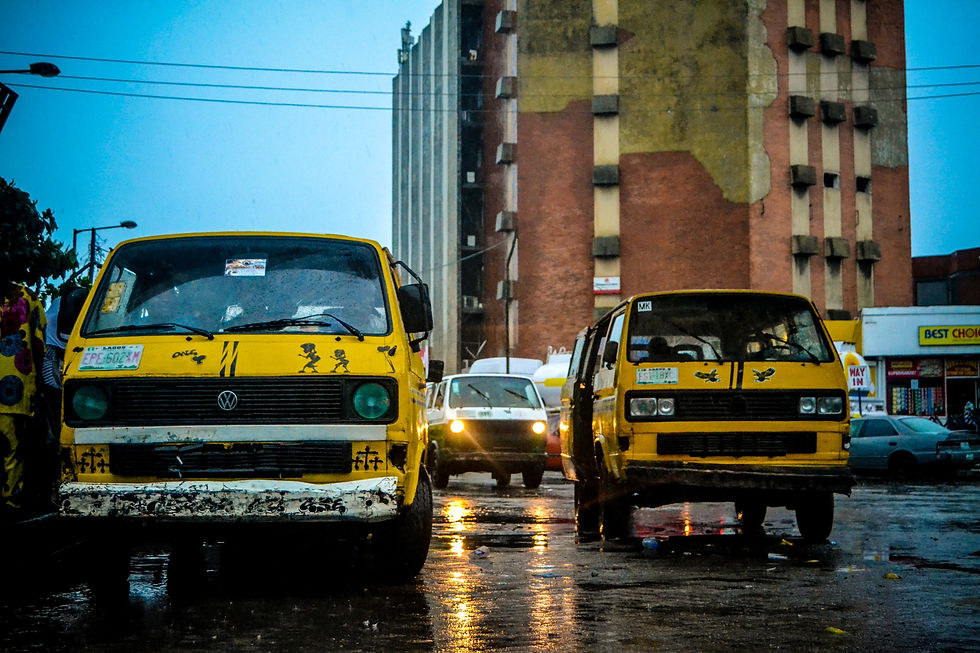
A danfo brushed my car today.
There was no excuse for it. I was driving at a decent speed, perhaps even slower than most drivers. I was going in my lane, and I had made no maneuver to overtake any other vehicle on the road.
And yet, it happened. The driver didn’t as much as look at me in the aftermath of making contact, and it took every bit of mental strength in me to not hurl obscenities in the direction of him and his passengers.
And so, naturally, it gave me an idea for an article, and this little incident formed the inspiration for the article that you’re currently reading.
Today, I want to talk about something many of us experience daily but rarely pause to reflect on—public transport. If you live in a major African city like Lagos, Nairobi, or Accra, you already know that getting from one part of town to another is often a frustrating, exhausting, and sometimes dangerous ordeal. Yet, for a continent rapidly urbanizing, public transport isn’t just about convenience. It’s about equity, economic opportunity, and the quality of everyday life.
The State of Public Transport in African Cities
Public transport in many African cities exists in a kind of informal chaos. In Lagos, where I live, for instance, millions of residents rely on danfos, which are privately owned, yellow minibuses notorious for their recklessness and unpredictability. In Nairobi, the matatu culture is both iconic and problematic, while in cities like Johannesburg, minibus taxis carry the bulk of daily commuters.
What these systems have in common is their informality. They fill a crucial gap in the absence of organized, state-led mass transit, yet they operate without proper regulation, safety standards, or reliable schedules. And for the people who depend on them, daily commuting means navigating a system built on improvisation rather than planning.
The Cost of a Broken System
The problem with unreliable public transport goes beyond mere inconvenience. It has serious implications for economic productivity and social mobility. According to a 2023 report by the African Development Bank, urban traffic congestion costs African economies an estimated $15 billion annually in lost productivity. In Lagos alone, commuters lose an average of 30 hours a week to traffic — valuable time that could be spent working, studying, or even resting.
Poor public transport also deepens inequality. Inaccessible, expensive, or unreliable transport systems lock out lower-income citizens from job opportunities and vital services. When the cost and stress of daily commuting eat into people’s income and well-being, it contributes to cycles of poverty that are hard to break.
Learning from the Past
What makes this frustrating is that African cities weren’t always so dysfunctional in their mobility systems. If you look back at colonial-era transport infrastructure, many cities had basic but functional rail systems and tramlines. Lagos, for instance, once had an operational rail network linking Marina to Ebute Metta. Over time, however, urban planning became reactive rather than proactive, with city growth outpacing investment in infrastructure. It is often said that we have a poor maintenance culture in this part of the world, and more often than not, this is proven true time and time again.
By the 1970s and 80s, population booms and rising car ownership led to sprawling, congested cities. Governments focused more on road expansion than on efficient public transport, and the result was predictable: roads built for 1 million people now carry 20 million, and the informal sector had to step in to fill the gap.
The late, great Fela Kuti once referred to the notorious danfos gallivanting around Lagos as “49 sitting, 99 standing,” a humorous and exaggerated yet not entirely untrue picture of the density of these small, often rickety buses, whose drivers seem to be more than willing to sacrifice passenger convenience for slightly more money.
What African Cities Need Now
Solving Africa’s transport crisis requires more than just building roads. It demands a deliberate rethinking of urban mobility. Mass transit systems like bus rapid transit (BRT) lines, light rail, and ferry services must become central to city planning.
Cities like Addis Ababa have shown what’s possible with the introduction of their modern light rail system, carrying over 120,000 passengers daily and reducing commute times by half in some areas.
In Lagos, the government deserves credit for making steady progress in this direction. The city is actively developing the rail systems, with the Blue Line and Red Line already operational and the Green Line in development. These projects, once fully functional, are expected to move hundreds of thousands of commuters daily, easing the strain on road traffic.
Additionally, I think Lagos also deserves commendation for the incorporation of Cowry, a contactless payment system, across its BRT network to allow for seamless, cashless transactions and route integration. It’s a model that, with sustained investment and expansion, could be replicated in other African cities.
Beyond the infrastructure, however, cities need to make commuting humane again. That means transport policies that prioritize safety, affordability, and accessibility. It also means integrating digital technology like cashless payment systems, real-time tracking apps, and route planning tools to make urban mobility efficient and predictable.

Lagos State’s proposed rail network—Courtesy of Bisi Adedun, Estate Intel.
My Thoughts
For me, public transport isn’t a side issue. It’s central to how African cities will either thrive or buckle under the weight of their growing populations. If we want inclusive cities where people can access jobs, education, and healthcare without enduring daily ordeals, we have to treat mobility as a human right, not a privilege.
As someone who’s grown up in a society heavily reliant on danfos, okadas, molues, and other less optimal forms of public transport, I’ve experienced both the upside and the downsides of having these as the primary form of getting from Point A to Point B, and I strongly believe we can do better, especially in the 21st century.
Also, as these mass transit systems like rail lines and BRT corridors expand and gradually phase out older, informal systems, I believe the governments must be intentional about creating alternative pathways for these drivers.
One solution, and the first that comes to my mind, would be to integrate them into the formal transport system, offering opportunities as BRT or ferry operators, maintenance staff, or route managers, or training them for logistics and haulage services that will remain essential.
Another would be to provide retraining programs and financial support schemes that help them transition into other sectors like ride-hailing, small logistics businesses, or even technical trades. That way, we can kill two birds with one stone by both phasing out these archaic means of transport and also preventing potential unemployment for the people involved in these by ensuring they secure new means of livelihood.
Development should never come at the cost of livelihoods without a safety net or a plan. The real test of leadership is how you carry people along, not how quickly you leave them behind, and I think that’s one aspect of leadership that the government has continually faltered in, in Lagos particularly.
Every time I sit in traffic or watch pedestrians dodging reckless danfo drivers or, you know, get my car brushed by a reckless danfo driver, I’m reminded that a city’s transport system reflects its priorities. And if our cities are to have a livable, dignified future, public transport has to be at the heart of the conversation.
Final Word
Public transport isn’t a luxury; it’s a lifeline for the majority of Africans who move through our cities daily. Without reliable, safe, and efficient systems in place, economic growth will always be stunted because people and goods simply can’t move as they should. It’s encouraging to see cities like Lagos making visible strides with the Blue and Red Line rails and the Cowry payment system, but this must be the standard and not the exception.
The future of African cities depends on bold investments in infrastructure and policies that treat mobility as a fundamental right, not an afterthought. The earlier we realize this, the better for everyone.


Comments