_edited.png)
The Role of the Joint Revenue Board in Nigeria’s New Tax Regime
- Ayomide "Mide" Alabi
- Dec 16, 2025
- 3 min read


In discussions of tax reform, we often focus on new rates, incentive thresholds, or reliefs for businesses and individuals. Yet equally important is the question of how tax authorities at federal, state, and local levels coordinate their work. That is where the institutional body formerly known as the Joint Tax Board (JTB) comes into view.
From my review of the reform legislation and policy commentary, the JTB’s successor structure is set to play a far more critical role in Nigeria’s fiscal federalism era.
From coordination to consolidation
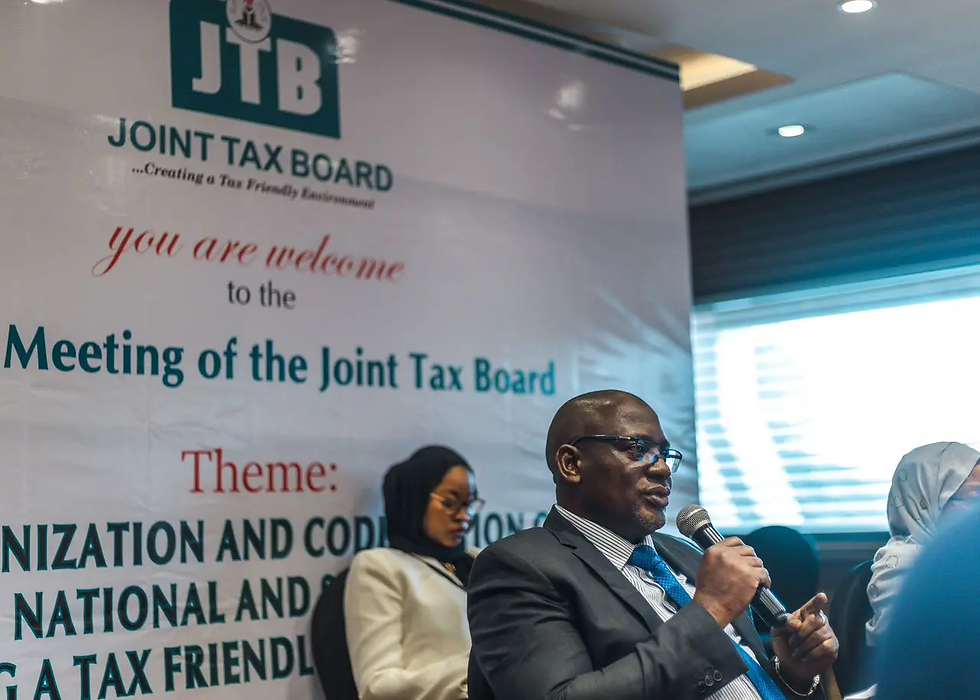
The Joint Tax Board was established decades ago to enable a loose form of coordination between the federal tax service and state internal revenue services, especially on personal income tax matters.
The challenge has always been overlap: multiple tax authorities, fragmented rules across states, inconsistent taxpayer data, and duplication of enforcement rights. That fragmentation undermined fairness, compliance, and revenue collection.
Under the new tax laws that take effect from 1 January 2026, the legislative reforms establish a new body—the Joint Revenue Board (JRB)—to replace the JTB.
The JRB is explicitly designed to expand the remit of intergovernmental tax coordination. Among its functions are harmonizing revenue administration across tiers of government, resolving jurisdictional disputes, publishing tax expenditure reports on waivers and exemptions, and maintaining a national taxpayer identification database.
For the layman, this means the old system of each state and the federal body operating in silos is being formally replaced by a single platform for policy alignment and shared enforcement.
Why this matters for tax policy and citizens
There are several reasons the reform of the JTB into the JRB is important:
Uniform compliance standards: Businesses and individuals operating across states will face more consistent processes, which reduce administrative cost and uncertainty.
Data sharing and central registration: With a national taxpayer identification platform, duplicate registration across states may decline, and taxpayer visibility will increase.
Dispute resolution: The new structure provides for mechanisms to address double taxation or overlapping demands from multiple authorities.
Transparency and accountability: By publishing tax expenditures, waivers, and exemptions, the JRB will support public scrutiny of how tax policy is administered.
Mobilization Support for states: Many states struggle with capacity for revenue mobilization. A coordinated board can help with capacity building, best practices, and avoiding a “race to the bottom” where states compete by offering unilateral reliefs.
For ordinary taxpayers, these changes may manifest in fewer duplicative tax demands from state and federal bodies, simpler registration, clearer rights and recourse, and a more predictable tax environment.
For businesses, especially those operating in multiple states, the benefits of harmonized procedures and fewer jurisdictional surprises could be significant.
The risks, and what to watch
While the reform is well designed on paper, the success of the transition will depend on a number of factors:
State buy-in: Some states may resist what they view as a diminution of their revenue autonomy. Without full cooperation, the JRB’s coordination power may be limited.
Capacity disparity: State internal revenue services differ widely in resources and capability. Harmonizing standards requires bridging gaps, not just drafting new bodies.
Legal clarity and enforcement: The new laws establish the board and functions, but operational rules, implementation regulations, and enforcement mechanisms must follow. Until the statutory instruments are issued, there will be uncertainty for taxpayers.
Balance between harmonization and federal dominance: After reform, the fear among some stakeholders is that federal control may increase under the guise of “coordination,” which could undermine genuine fiscal federalism.
Practical tips for taxpayers and businesses
If you operate or earn income in more than one state, review your registration status and ensure your Tax Identification Number (TIN) is properly recognized in each jurisdiction.
Stay alert for circulars or guidance from the state internal revenue service and the newly constituted board. Implementation may vary across states.
Maintain documentation of tax payments, demands, and correspondence; the new dispute resolution framework may encourage challenges, but you’ll need records regardless.
For businesses, map your operations across states and assess whether harmonized tax processes can reduce your compliance burden or risk of double tax.
Follow public disclosures and consult credible media coverage of the board’s published tax‐expenditure reports; this is a new channel for citizens and businesses to hold revenue authorities accountable.
A final outlook
The replacement of the JTB with the JRB under Nigeria’s new tax laws is more than a name change. It signals a structural shift in how revenue administration will be coordinated across federal and sub-national levels.
For those of us tracking tax reform, it is a promising development that could support greater efficiency, fairness, and transparency.
However, the promise is not a guarantee. Success will depend on implementation, stakeholder buy-in, institutional capacity, and legal clarity.
As Nigeria turns the page on its old tax architecture, the efficiency of this board will be one of the key variables in whether the reforms truly benefit taxpayers and the economy.


Comments